Qualify Inbound Leads with AI, Without Blind Trust
A practical guide to AI lead qualification: a deterministic gate, a model that explains its reasoning, and routing that decides the next step in seconds.
Moin Dalal
October 4, 2026
Inbound leads go cold while they wait. Someone fills in your form, opens a chat or sends an email. Then they wait. By the time your team reads the message, decides if it is worth a call and writes back, the buyer has often talked to someone else. A slow first reply lowers your chance of ever winning that lead. That is the problem, and it is why so many teams put an AI model in front of their inbox.
Most teams make the same mistake. They hand every message to a model, ask it to “qualify the lead”, and hope. When the model gets it wrong, nobody can see why. When the message is junk, they still pay for a model call to find that out. This post shows a better way to qualify leads with AI. I used it to build CAT-01, the Instant Lead Agent.
Start with what you are actually deciding
Qualification sounds like one decision. It is really three:
- Is this a real, readable enquiry? An empty form, a garbled paste or an obvious bot is not a lead. You do not need judgment here. You need a check.
- How good is the lead? This is where AI earns its keep. “We need this live by next month and our budget is approved” means something very different from “just curious what you do”, even when both come through the same form.
- What should happen next? A strong lead might get a booked call right away. A weak one might get a polite reply and nothing more. Someone has to decide, and they should decide the same way every time.
If you put all three into one big instruction to the model (prompt), you cannot check its answer. If you split them, each step uses the right tool: plain rules for the first, a model for the second and a routing table for the third.
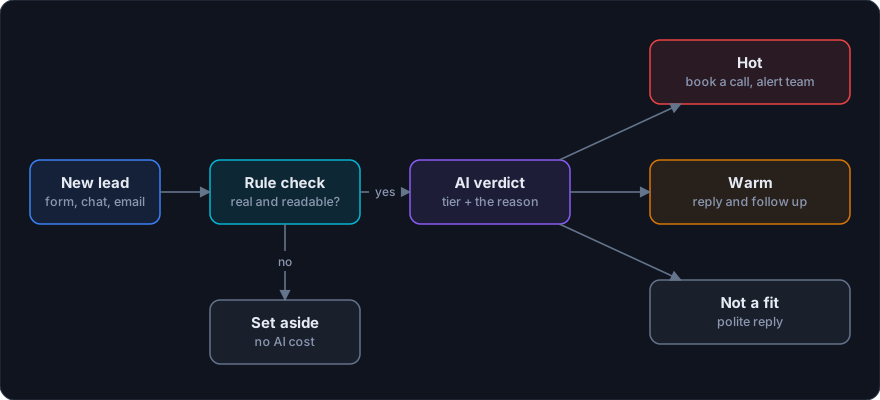
Step one: a deterministic gate
Each channel sends messages in its own shape: a web form looks different from a chat widget or an email. Before the model sees anything, turn every message into one standard shape (normalise). That shape holds who sent it, how to reach them, what they said and where it came from.
This clean-up step also works as a gate. It follows fixed rules and always gives the same answer for the same input (deterministic). If a message is broken, the gate stops it before it reaches the model and sets it aside for a person to check. You spend nothing on a model call to learn that the message was broken.
This helps in two ways. First, your costs stay predictable, because you only pay the model to judge messages that deserve it. Second, you can tell your failures apart. “The message was broken” and “the model was unsure” are different problems, and you want to see which one happened.
Keep the gate boring. You should be able to read its code in a minute, not take it on trust.
Step two: a model that shows its reasoning
Every message that passes the gate goes to a live AI model, which reads the lead’s own words. A bare score is not enough. The model should give you three things:
- A tier: hot, warm or spam.
- A budget score, so you can see how the model read the money signals in the message.
- Its reason, in plain English.
Most teams skip the reason, yet the reason is what makes the system usable. Say the model marks a lead warm and your salesperson disagrees. The reason shows exactly what the model read into the message. Maybe it fixed on one phrase. Maybe it missed a deadline the lead mentioned in passing. Either way, you now argue about evidence instead of shrugging at a black box.
The same model call also drafts a personal first reply. This is where the speed comes from. Your team no longer starts from a blank page. They already have a draft that mentions what the person asked about. They can send it as it is, tweak it or throw it away. Either way, the first reply goes out in minutes, not hours.
Step three: let the tier decide the next move
Once the model sets a tier, the next step should follow on its own. In CAT-01 a hot lead can become a record in your sales contact system (CRM), a held booking slot, a WhatsApp or email follow-up and an alert to your team. A lead that is not a fit gets a polite reply instead of silence. That protects your reputation better than ignoring them, and it costs less than a long back-and-forth.
Look at what this does to your team’s job. Nobody sorts the inbox by urgency (triage) any more. They look at a short list the system has already sorted. Each lead comes with a reason and a reply ready to go. Your people spend their time on the leads that need a person.
Keep a human in the loop where it counts
Automation does not mean removing people. Match the amount of freedom you give the system to the cost of a mistake:
- Drafting a reply costs little if it goes wrong, because a person reads it before it goes out. Automate it.
- Alerting your team costs little too. Automate it.
- Sending a message to a stranger under your name, with no review costs a lot if it goes wrong. Start with a draft. Remove the review only after you have watched the system get it right for a while.
I apply the same rule to my own contact form. My plan: the agent labels each message and drafts a reply for me to review. It never replies to the visitor by itself.
Why I built it on n8n
I built the whole CAT-01 agent in a visual workflow tool (n8n) that shows each step, so you can open it and read it. I chose it for ownership. The workflow ships as a bundle that runs on the client’s own server, so the client owns the data and the logic. Changing a routing rule does not need a developer. If your qualification logic lives inside a vendor’s black box, every change becomes a support ticket. If it lives in a workflow you can read, your sales manager can change it.
What to measure
If you build something like this, track three numbers from day one:
- Time to first reply. The whole system exists to shrink this number.
- How often a person overrides the tier. If people override it often, the model’s reasoning is off, and its written reasons show you where.
- How many messages the gate sets aside. A sudden jump usually means a form or connection upstream has broken, long before anyone complains.
The short version
Split the decisions. A deterministic gate catches broken input. A model that explains itself judges quality. A routing step turns the verdict into action. Keep a person in charge wherever a mistake costs a lot. Do that, and every new lead gets a thoughtful reply in seconds instead of going cold in your inbox.
Want to see it work on your own lead messages? The CAT-01 case study explains how to request a private demo link. If you are working on a similar problem, book a call and we can talk it through.